
As Odisha and West Bengal are bracing for a severe cyclonic storm, governments of both states started evacuating people and while deciding to close educational institutions in vulnerable areas.

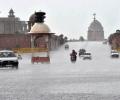
As many as 12 flights were diverted at the Delhi airport between 3 pm and 4 pm due to adverse weather conditions, an official said.
The IMD chief also allayed fears of occurrence of an El-Nino.
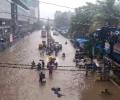
The Army unit deployed in Ashti successfully evacuated 40 people with the help of an NDRF team and other agencies.

At least 14 people have died in rain-related incidents as thunderstorms, strong winds and dust storms battered several parts of Gujarat, India. The India Meteorological Department (IMD) has forecast thunderstorms with lightning and strong winds of up to 50-60 kmph across the state for the next few days. Strong winds uprooted trees, hoardings, and pillars, and parts of houses collapsed in several districts, leaving many injured. The deaths were reported in Ahmedabad, Anand, Kheda, Dahod, Aravalli and Vadodara districts of Gujarat on Monday and Sunday. The IMD has also forecast heavy rainfall in isolated parts of Banaskantha, Kutch, Sabarkantha, Aravalli and Anand districts in the next three days.

IMD data shows in the 24 hours between September 1 and 2, Haryana received 806 per cent more rainfall than normal, Punjab 759 per cent, Himachal Pradesh 510 per cent, Delhi 740 per cent, Chandigarh a staggering 1,638 per cent, and Rajasthan 193 per cent.

June rainfall accounts for 15 percent of the total precipitation of 87 cm recorded during the four-month monsoon season in the country.

A landslide in the Vikhroli suburb of Mumbai killed two people and injured two others after heavy rains caused soil and stones to collapse on a hut.

Heavy rains lashed Mumbai and its suburbs on Thursday, causing waterlogging on roads in some areas that led to traffic snarls and also delayed local train operations.

The southwest monsoon has arrived in Mumbai 16 days before its usual date, making it the earliest arrival since 1950. This early onset follows the monsoon's arrival in Kerala, the southernmost state, on Saturday, marking the earliest arrival since 2009. The India Meteorological Department (IMD) predicts an above-normal rainfall for the 2025 monsoon season, with rainfall between 96 per cent and 104 per cent of the 50-year average of 87 cm considered 'normal'. The monsoon is crucial for India's economy, providing vital water for agriculture and replenishing reservoirs.

July and August are expected to receive 107 per cent and 104 per cent of rainfall

Delhi's air quality deteriorates to 'very poor' levels, sparking a blame game between AAP and BJP over the causes and responsibility for the pollution.

The aircraft, later, flew to Guwahati after an improvement in the weather conditions in Guwahati, said KC Meena, the director of the Maharaja Bir Bikram (MBB) Airport at Agartala.
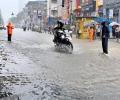
Mumbaikars woke up to very heavy rainfall on Monday, while the India meteorological department (IMD) issued a 'red' alert, forecasting extremely heavy rains at isolated places in the city and adjoining areas, prompting the civic body to declare a holiday for schools and colleges, officials said.

The India Meteorological Department (IMD) has forecast cloudy skies with the possibility of heavy rainfall at a few places in the city and suburbs in the next 24 hours.

As the Northeast monsoon intensified across Tamil Nadu, the regional weather office issued heavy rainfall alert to a number of districts. Chief Minister M K Stalin reviewed the situation and directed precautionary measures.
Heavy rains in Maharashtra have caused floods, road blockages, and widespread damage, resulting in casualties and displacement. The state government is monitoring the situation and coordinating rescue efforts.

The IMD on its part is sticking to its forecast of July rainfall.

This would be due to early monsoon onset, abundant precipitation in the soil and the government's higher minimum support price (MSP) for farmers, the USDA said in its assessment.

Temperatures are likely to remain in a similar range until Thursday, with a gradual fall expected from June 13.

Skymet says the IMD ignored the required criterion of two days of necessary rainfall to declare a proper onset of monsoon, reports Sanjeeb Mukherjee.

India has received 20 per cent less rainfall since the start of the monsoon period on June 1, with the rain-bearing system making no significant progress between June 12 and 18, according to the India Meteorological Department (IMD).

According to an IMD forecast issued on Thursday, a heatwave spell will persist over northwest and central India during the next five days and over east India during the next three days.

India is set to experience extreme heat during the April to June period, with the central and western peninsular parts expected to face the worst impact, the IMD said on Monday as the country prepares for seven-phase general elections from April 19.

The BCCI press conference scheduled at 1.30pm in Mumbai is 'expected to be delayed owing to weather disruptions'.
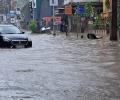
The IMD issued a "Nowcast" warning, forecasting thunderstorms accompanied by lightning and intense spells of rain with gusty winds reaching 50-60 kmph at isolated places in Mumbai in the next three to four hours.

'AI can be very useful for making analysis and especially making city-based local forecasts.'

'Nobody asked us to work on this. It was on our own that we decided to embark on this journey.'

According to the IMD, a rain event is categorised as a cloudburst if a weather station receives 100 mm of rain in one hour.

Besides strengthening the IMD's infrastructure, Mohapatra said his priority will be to improve the dissemination of weather-related information -- from nowcasts to weather forecasts -- focus on sector-related forecast and give impact-based prediction in all areas.

The southwest monsoon is expected to reach Kerala during the next two to three days, marking a sluggish start to the seasonal rains that are the lifeline of India's agri-based economy.

Skymet expects a good monsoon over western and southern India.

India is likely to see above-normal rainfall in the four-month monsoon season (June to September) with cumulative rainfall rainfall estimated at 106 percent of the long-period average (87 cm), he said.

Heavy waterlogging was witnessed in several towns and cities, while roads were closed in rural areas on Friday morning due a heavy spell.
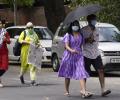
The India meteorological department said heatwave conditions will persist for at least two more days.

As per IMD classification, "heavy to very heavy rainfall" means precipitation ranging from 64.5 mm to 204.4 mm in a period of 24 hours.

Scores of people die every year due to cold waves that sweep across the north Indian plains.

It expects rainfall to be about 106 per cent of the long period average, aided by La Nia conditions anticipated to play a role in the second half of the monsoon season.
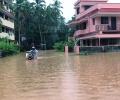
Heavy monsoon rains battered Karnataka's coastal belt for the third consecutive day on Monday, severely disrupting normal life in Dakshina Kannada district, prompting authorities to issue a red alert and deploy disaster response teams. A red alert indicates extremely heavy rainfall of over 20 cm in 24 hours, and will remain in force for the next five days, according to the India Meteorological Department (IMD). Several parts of Mangaluru city reported waterlogging and traffic snarls, while minor incidents of landslides were reported from hilly regions across the district. The district administration has directed schools and composite colleges to remain shut on 27 and 28 following the IMD issuing a red alert. Instructions were also issued to relocate residents living in vulnerable hillside and riverside areas to safer locations. The authorities have sought prompt action from the National Highways Authority of India (NHAI) following complaints of water intrusion in residential areas due to ongoing highway construction works.

The BMC declared a holiday for all government and private schools and colleges in Mumbai on Thursday after the IMD issued a 'red' alert for the metropolis.
